
【Column】United Daily News|“No Legal Obligation to Report” — Is That the Answer for National Governance?
“No Legal Obligation to Report” — Is That the Answer for National Governance?
August 12, 2026, 00:00
By Lee Po-Chang/Distinguished Professor, College of Public Health, Taipei Medical University (Taipei)
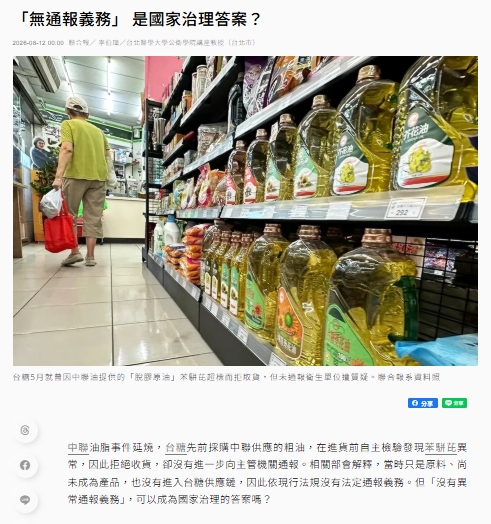
The controversy surrounding Chung Lien Edible Oil continues to unfold. Taiwan Sugar Corporation had previously purchased crude oil supplied by Chung Lien. Before accepting the shipment, Taiwan Sugar conducted its own inspection and found abnormal levels of benzo[a]pyrene, and therefore refused to accept the shipment. However, it did not further report the matter to the competent authorities. Relevant government agencies explained that the material was still a raw ingredient at the time, had not yet become a finished product, and had not entered Taiwan Sugar’s supply chain. Therefore, under the current regulations, there was no statutory obligation to report it.
But can “there is no legal obligation to report an abnormality” really be the answer for national governance?
If a state-owned enterprise discovers that a supplier’s food ingredient is abnormal, the important question should not simply be, “We won’t accept this shipment.” We should also ask: Did the same supplier sell the same raw material to other companies? Did the problem originate from the same batch, the same source, or the same manufacturing process? Have other consumers already been exposed to the risk?
People are dealing with one government—not a government divided into the Ministry of Economic Affairs, the Taiwan Food and Drug Administration, and local health bureaus operating separately from one another.
Since 2010, the Taiwan Food and Drug Administration (TFDA) has established a “Drug Efficacy Discrepancy Reporting” mechanism. If physicians discover that a patient’s blood pressure, blood glucose, or blood lipid levels become less well controlled after switching to a different brand of the same active ingredient and dosage, or if the therapeutic effect appears to differ, they can report the issue to the TFDA.
In practice, however, clinical physicians see patients one after another. If they have to leave the National Health Insurance Administration’s existing online system, visit the TFDA website separately, log in again, and re-enter all the relevant information, even a well-designed system can easily become a burden. A physician may simply find it faster to switch from Drug A to Drug B.
In 2018, when I was serving at the National Health Insurance Administration (NHIA), and in support of the development of domestic generic drugs as well as the principle of “one government,” the NHIA worked with the TFDA to integrate the reporting function directly into the NHI cloud-based system that physicians use every day. When physicians encountered concerns about a patient’s medication, they could report them directly through the NHIA system. The NHIA would then periodically consolidate the data and provide it to the TFDA for professional assessment and follow-up.
There are thousands upon thousands of food and pharmaceutical ingredients, products, and batch numbers. The government cannot rely solely on limited manpower to inspect them one by one. Simply expecting the TFDA to conduct random inspections is, in essence, still close to shooting in the dark.
In the digital age, truly effective governance should establish a nationwide “national risk radar” based on public participation: reporting, data accumulation, anomaly detection, risk classification, and targeted inspections.
A single abnormal report may be an isolated case. But if ten or twenty reports are concentrated on the same product, batch number, raw-material source, or factory, an immediate warning should be generated and an investigation launched—not wait until an incident occurs before conducting a comprehensive inspection.
The same principle applies to pharmaceuticals. At a time when Taiwan has yet to fully implement user charges and copayments as tools to manage unnecessary medical care, the NHIA has been using lower drug prices to control overall pharmaceutical expenditures. Yet the costs of raw materials, manufacturing, labor, and quality management cannot decline indefinitely. Under such circumstances, the government should simultaneously strengthen post-market quality surveillance.
Patients are the ones taking the medication, so they are often the first to feel whether it works effectively. Physicians observe treatment outcomes every day and are therefore also in a position to detect abnormalities at an early stage.
The same applies to food. The first people to notice a problem may be procurement personnel, food manufacturers, laboratories, distributors, or even consumers.
The government should not try to grow ten thousand pairs of eyes of its own. Instead, it should establish a system in which the 23 million people across Taiwan can all potentially become risk sensors for the nation.
Therefore, the most important lesson from the Chung Lien edible-oil incident should not simply be to add a few more penalties. It should be to rebuild our culture of governance.
A mature society is not one in which everyone clearly says, “This is not my responsibility.” Rather, when a public risk emerges, someone should still be willing to say:
“Although the law does not require me to report it, I do not want the next person to be harmed because of it.”
That is the attitude that national governance should truly embody.
Original source: https://udn.com/news/story/7339/9685454


