EVENT PHOTOS
活動花絮



【2026/01/20】
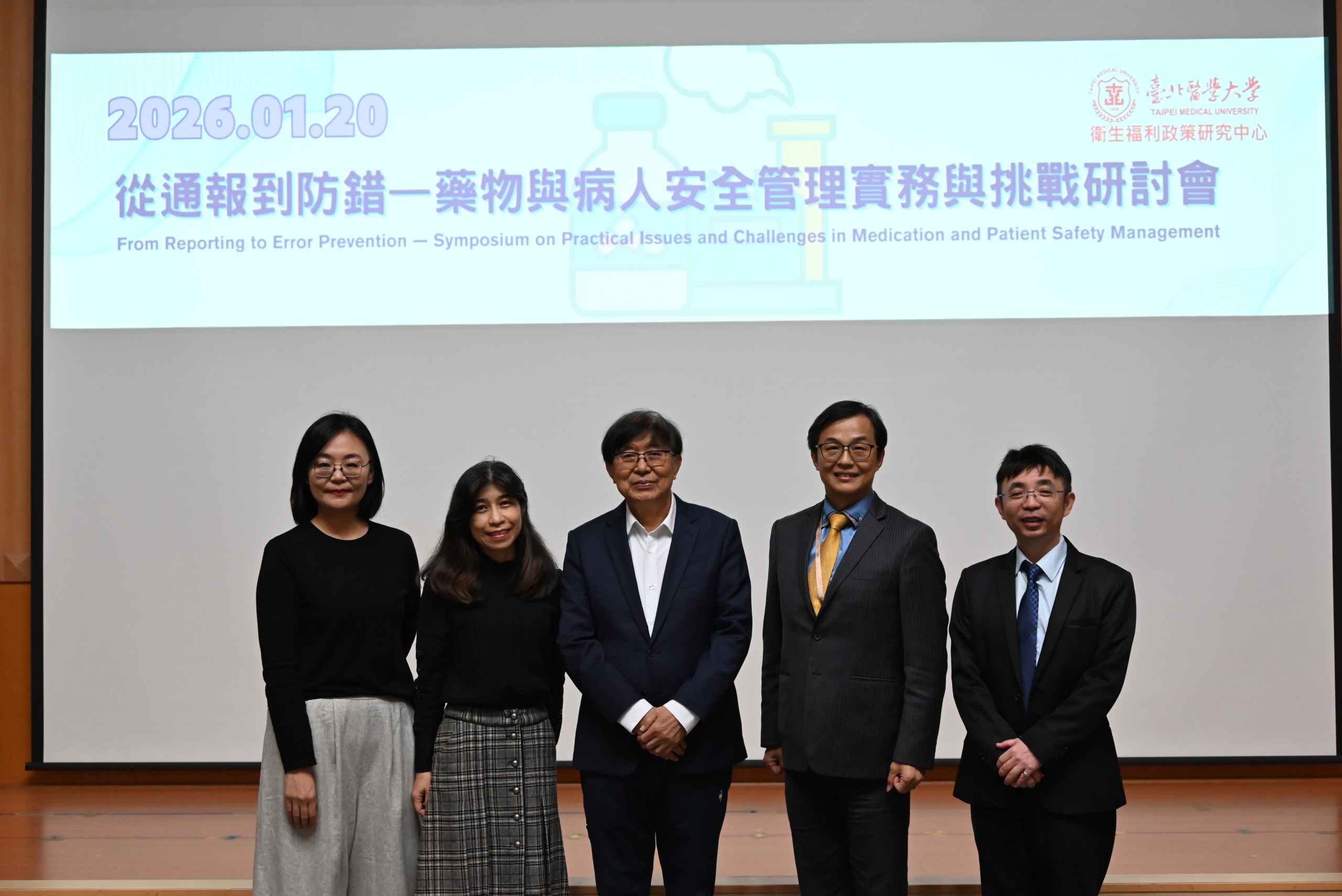

(From left to right: Shen Wan-Jen, Director of the Department of Pharmacy, Shuang Ho Hospital; Chen Wen-Wen, Chief Executive Officer, Taiwan Drug Relief Foundation; Lee Po-Chang, Director, Center for Health and Welfare Policy Research, Taipei Medical University; Chiang Chih-Kang, Director-General, Taiwan Food and Drug Administration, Ministry of Health and Welfare; Chen Hsi-Hsien, Director, Department of Healthcare Quality, Taipei Medical University Hospital)
The Center for Health and Welfare Policy Research at Taipei Medical University held the “From Reporting to Error Prevention—Practical Issues and Challenges in Medication and Patient Safety Management” Symposium on January 20, 2026. The symposium focused on building institutional frameworks for medication error prevention and patient safety reporting, exploring ways to strengthen error-prevention processes and improve reporting effectiveness. The goal was to promote continuous improvement in safety culture and quality management within healthcare institutions, making safe medication use a shared cornerstone of public trust in healthcare.
Lee Po-Chang, Director, Center for Health and Welfare Policy Research, Taipei Medical University

In his opening remarks, Director Lee stated that patient safety and resilient healthcare are critical issues facing today’s healthcare system. Hospitals have already achieved notable progress in promoting smart medication services; whether through AI applications or other intelligent technologies, these tools play a key supportive role throughout the medication-use process. Nevertheless, medication administration still relies heavily on nurses strictly adhering to core safety checkpoints such as the “three reads and five rights,” which are essential to ensuring patient safety. He expressed hope that the day’s discussions would further deepen exchanges and reflection on medication safety and patient safety issues.
Chiang Chih-Kang, Director-General, Taiwan Food and Drug Administration (TFDA), Ministry of Health and Welfare

Director-General Chiang emphasized that the core purpose of pharmacovigilance is to detect, assess, understand, and prevent medication-related risks, thereby compensating for the limitations of clinical trials in terms of population size and real-world use scenarios. Pharmacovigilance is therefore an indispensable component of modern drug regulatory systems. Taiwan’s pharmacovigilance framework is legally grounded in the Pharmaceutical Affairs Act, supported by pharmacovigilance regulations, serious adverse drug reaction reporting mechanisms, and Good Pharmacovigilance Practices (GVP). Through a combination of active and passive surveillance, the system integrates adverse reaction reports, drug injury relief cases, domestic and international safety alerts, and data from National Health Insurance and Ministry of Health and Welfare databases as key inputs for risk assessment and management.
Director-General Chiang noted that the TFDA has implemented multiple drug risk management measures in practice, including issuing safety alerts, strengthening drug label warnings, restricting use in high-risk populations, revising package insert warnings, aligning with international drug safety alerts, and withdrawing drugs from the market when risks outweigh benefits. He cited examples such as identifying the risks of a medication for kidney disease through the national adverse drug reaction reporting system, leading to the addition of new contraindications, as well as establishing risk assessment and control programs for tuberculosis. An evaluation of a TB risk management program using National Health Insurance data in 2018 showed a declining trend in pulmonary tuberculosis incidence. He concluded by emphasizing that the TFDA will continue to enhance the timeliness and dynamic assessment capacity of post-marketing drug safety surveillance, further integrate real-world data, and establish real-time, adjustable, and verifiable regulatory decision-making models to comprehensively strengthen the resilience of Taiwan’s drug safety governance and achieve the core goals of medication and patient safety.
Chen Hsi-Hsien, Director, Department of Healthcare Quality, Taipei Medical University Hospital

Director Chen stated that patient safety and medication quality are concrete manifestations of a hospital’s governance capacity and safety culture. Taipei Medical University Hospital has long emphasized institutionalized governance, data-driven management, and technological support. The Department of Healthcare Quality coordinates data analysis to help clinical and allied health units integrate patient safety goals into daily operations.
In terms of medication safety, the hospital focuses on high-risk stages of medication-related events. Patient safety reports show that medication events have consistently been the most common type of incident. In 2023, approximately 6.5% of these events resulted in patient harm, with human factors accounting for 67% and system factors for 31%. The most frequent stages of occurrence were order prescribing and entry (41.9 cases per 100 incidents), followed by medication administration (12.9 per 100) and pharmacy dispensing (7.7 per 100).
To address these risks, the hospital introduced BI visualization dashboards and a red–yellow alert management system (two consecutive red alerts or three yellow alerts indicate potential abnormalities in a unit) to monitor risk trends in real time. Smart support measures—such as duplicate medication alerts and blocks, and proactive adverse drug reaction reporting—have increased system protection rates to 99.9%. Additionally, by integrating patient wristbands with medication package barcode scanning, the hospital has fully implemented a closed-loop medication administration process, preventing progression to the next step if procedures are not followed. All records are stored electronically, strengthening process control while simplifying ward medication workflows. Concrete outcomes include a 99% reduction in medication returns and an average dispensing time of 7 seconds per transaction.
The hospital also promotes a non-punitive, improvement-focused reporting culture, using graded management and root cause analysis to transform incidents into opportunities for system optimization and education. Patient safety WalkRounds further ensure that frontline staff understand the value of reporting abnormal events, fostering a positive patient safety culture.
Shen Wan-Jen, Director, Department of Pharmacy, Shuang Ho Hospital

Director Shen noted that healthcare has long adopted information systems to gradually build a comprehensive medication safety protection network. From physician diagnosis and prescribing to every step before medication reaches the patient, error-prevention and interception mechanisms are in place to help healthcare teams identify high-risk medication scenarios in real time and reduce errors.
Using chemotherapy patients as an example, she explained that information systems can automatically populate patient age, weight, and relevant laboratory values required for prescribing, ensuring accurate dosing and appropriate use. Electronic records reduce manual entry errors and staff workload, while real-time visualized monitoring systems continue to safeguard patient safety. In recent years, Taiwan has actively introduced smart healthcare technologies—such as intelligent medication cabinets, drug identification systems, and smart dispensing—to reduce reliance on human memory. On the patient side, medication labeling has been continuously improved through visual symbols, English-language labels, and Braille stickers to enhance patients’ ability to take medications correctly.
Director Shen further noted that with the increasing use of cloud-based National Health Insurance data, pharmaceutical services are transitioning toward patient-centered integrated care, addressing medication waste and duplicate use. Hospitals therefore promote medication reconciliation and continuity of care at key points—outpatient visits, admission, and discharge—by comprehensively reviewing existing medications, communicating discrepancies with prescribers, and adjusting prescriptions when necessary. Shared decision-making has also been integrated into clinical care, with physicians and pharmacists clearly explaining treatment and medication options and encouraging patients to express their preferences and concerns, ultimately enhancing medication safety and mutual trust.
Chen Wen-Wen, CEO, Taiwan Drug Relief Foundation

CEO Chen explained that the inherent limitations of medicine, difficulty in clarifying liability, and the time- and resource-intensive nature of litigation are the reasons for the existence of the drug injury relief system. The system was established to address unpredictable risks in medical care, recognizing that no drug is 100% safe for everyone, and to provide timely and humane support to patients harmed despite appropriate and lawful medication use.
Since its implementation over two decades ago, the drug injury relief system has processed more than 2,500 compensated cases, with total payouts exceeding NTD 700 million, while also building a database of high policy value. The core value of this database lies in identifying high-risk drugs and vulnerable populations, recognizing emerging risk patterns, and focusing on severe cases with rigorously reviewed causal relationships.
CEO Chen cited successful identification of high-fatality risks such as severe cutaneous adverse reactions through big data analysis, enabling targeted risk management plans, genetic testing, dose adjustments, and public risk communication to improve early recognition of allergic skin reactions. Statistics show that these efforts have significantly improved trends in severe drug-induced skin injuries. She concluded that the drug injury relief system, patient safety reporting system, and national adverse drug reaction reporting system together form the “iron triangle” of medication safety protection. Going forward, deeper data analysis, cross-system integration, and close collaboration with pharmacovigilance and patient safety systems will help create a safer and more resilient medication-use environment.
Policy Recommendations (Conclusions)
Systematically integrate shared decision-making into clinical care processes, with physicians and pharmacists clearly explaining medication options and risks, guiding patients to express their needs and considerations, reducing information asymmetry, and improving patient engagement, adherence, and overall medication safety.
Strengthen hospital governance frameworks for patient safety and medication quality through multi-level decision-making and data-driven management, ensuring a closed institutional loop from policy formulation and implementation monitoring to outcome review.
Continue expanding digitalization and smart healthcare technologies, shifting risk control upstream to prescribing and dispensing stages through cloud integration, multiple verification steps, and high-risk alerts to reduce medication errors in vulnerable populations and special situations.
Effectively leverage drug injury relief big data to design prevention-oriented medication safety policies by identifying high-risk drugs and populations, strengthening guidelines, risk management, and precision medication strategies to reduce severe drug injury incidence.
Enhance the timeliness and dynamic evaluation of post-marketing drug safety surveillance, integrating more real-world data to establish real-time, adjustable, and verifiable drug safety decision-making models, improving precision and overall system resilience.
Related News Links
2026.1.20 — Safeguarding Medication Safety: Scholars Urge Frontline Reporting of “Unequal Drug Effectiveness”, China Times
https://www.ctee.com.tw/news/20260120701815-431401
2026.1.20 — Patient Safety Reports Rising! Medication Events Top the List; Scholars Call for AI to Address Workforce Gaps, United Daily News
https://udn.com/news/story/7266/9277282
2026.1.20 — Medication Errors Are Not Due to Unprofessionalism… Closed-Loop Medication Management Allows Systems to Apply the Brakes at Critical Moments, United Daily News
https://udn.com/news/story/7266/9277857
2026.1.22 — No More Fear of Taking or Using the Wrong Medication! What Are Taiwan’s Three Major Medication Safety Defenses in 2026?, HEHO Health
https://heho.com.tw/archives/374231
 【Opinion Column】Liberty Republic — Lee Po-Chang: Why I Chose to Revisit Health Insurance Reform Through the Lens of “Unnecessary Medical Care”2026-03-16 - 15:41
 【Opinion Column】Liberty Times “Liberty Square” — DET Should Have Been Reviewed and Abolished Long Ago: Pharmaceutical Policy Cannot Be Reduced to Price-Cutting Alone2026-03-16 - 15:39