
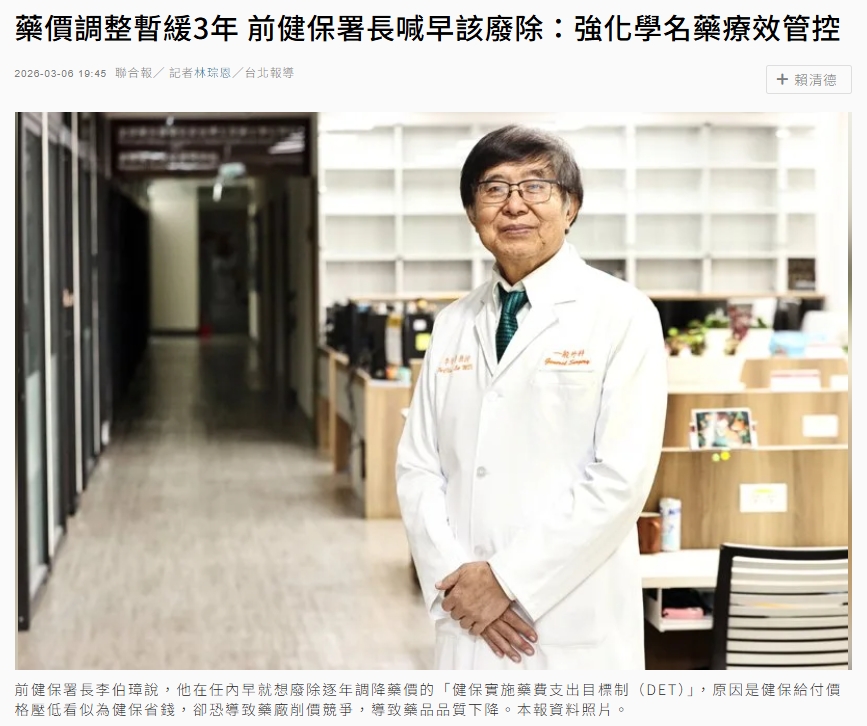
【Media Report】President Lai Ching-te recently proposed suspending drug price adjustments for three years, sparking heated discussion within the medical and pharmaceutical sectors.
President Lai Ching-te recently proposed suspending drug price adjustments for three years, sparking heated discussion within the medical and pharmaceutical sectors. Lee Po-Chang, former Director-General of the National Health Insurance Administration (NHIA), said he had already intended to abolish the system of annual drug price reductions—the Drug Expenditure Target (DET) under the National Health Insurance program—during his tenure. While lowering reimbursement prices may appear to save money for the NHI, he warned that it could push pharmaceutical companies into aggressive price competition, potentially leading to declining drug quality. In addition to ensuring reasonable drug prices, he also suggested that the government strengthen reporting mechanisms for unequal therapeutic effects among generic drugs, eliminating those that fail to meet efficacy standards and thereby further reducing pharmaceutical expenditures.
Lee explained that the original intention of the drug price adjustment mechanism was to keep pharmaceutical spending within 25% of the NHI global budget. However, as of last year, drug expenditures had reached 32.58% of the total NHI budget, showing a steady upward trend. Because there is often a gap between NHI reimbursement prices and actual market transaction prices, downward adjustments have been implemented. From the perspective of NHI resource management, such measures are reasonable, given that the NHI operates under a global budget system and must use its funds as efficiently as possible each year. However, he noted that intense market competition means pharmaceutical companies may lower prices while simultaneously cutting costs—which could ultimately compromise drug quality.
Lee stated, “During my tenure as NHIA Director-General, I had already considered abolishing the DET system. Pharmaceutical companies should be given reasonable profits when appropriate.” In addition to ensuring adequate profits for manufacturers, he emphasized the need to improve the quality of generic drugs. Currently, one major issue is insufficient manpower devoted to drug quality management. Although pharmaceutical companies must meet regulatory standards such as PIC/S GMP certification when drugs are first approved, continuous downward adjustments in NHI reimbursement prices may push manufacturers to modify production processes over time, potentially affecting quality. “It’s like children whose parents have no time to supervise them—they become more prone to mischief,” he said.
Huang Yan-Ju, spokesperson for the Pharmacists Association, noted that suspending the Drug Expenditure Target (DET) price survey mechanism for three years could provide time for institutional review and adjustment. However, he emphasized that it is even more important during this period to comprehensively reassess Taiwan’s pharmaceutical supply system and establish a more resilient drug supply framework to ensure that public access to medications is not disrupted by market fluctuations. He suggested that drug pricing reform should be integrated with broader “pharmaceutical resilience” policies to strengthen the stable supply of essential and commonly used medications.
Lee added that during his time at the NHIA, a mechanism had already been established allowing clinicians to report cases in which patients experienced unequal therapeutic effects from generic drugs when prescribing medications. He urged the Ministry of Health and Welfare to promote wider use of this reporting system. If reports concerning a particular generic drug become excessive, the Taiwan Food and Drug Administration (TFDA) should conduct on-site inspections of manufacturers, and the NHIA should consider removing ineffective drugs from NHI reimbursement. This would ensure more rational use of NHI resources. In addition, Lee emphasized that whether for pharmaceuticals or diagnostic tests, partial cost-sharing mechanisms based on the user-pay principle should be implemented to address healthcare waste.
Huang further stressed that reform of the drug pricing system should not focus solely on price adjustments. Instead, it should reassess the value of professional healthcare services within the medical system. During the suspension of the drug price survey mechanism, the NHI system could gradually shift resources from “purchasing drugs” toward “purchasing professional services.” He also suggested optimizing pharmaceutical service fees—for example, considering the introduction of a controlled drug management fee to reflect the actual operational costs of dispensing, managing, and reporting controlled substances. Such measures would help prevent primary care institutions and community pharmacies from operating at a loss while providing services, thereby safeguarding the public’s access to medications.
Original source:
https://udn.com/news/story/7266/9364402


