
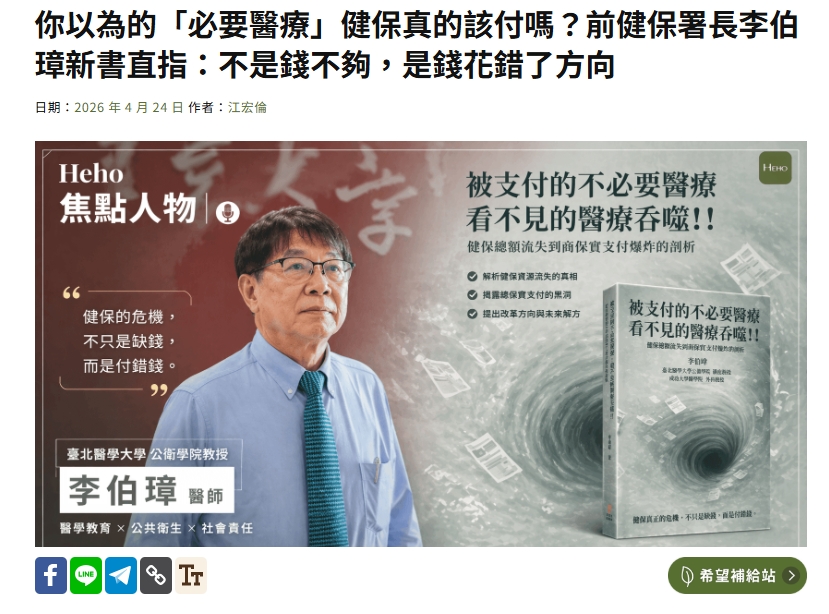
【Media Interview】Heho Health Should National Health Insurance Really Pay for What You Think Is “Necessary Care”? Former NHIA Director-General Po-Chang Lee’s New Book Argues the Real Problem Is Not Insufficient Funds, but Money Spent in the Wrong Direction
Have you ever wondered during a doctor’s visit: Are all the tests being arranged for you truly necessary?
Taiwan’s National Health Insurance (NHI) system is a source of national pride. With low premiums and easy access to care, many people have come to treat “going to the hospital for a check-up” as an almost automatic daily response.
Yet behind this highly utilized healthcare culture lies a question that has rarely been seriously asked:
What kind of medical care are we actually paying for?
The Problem Is Not a Lack of Money — It Is Money Spent in the Wrong Places
Former Director-General of the National Health Insurance Administration, Po-Chang Lee, wrote this book after leaving office:
Unnecessary Medical Care That Gets Paid For
Its central argument is direct—and perhaps uncomfortable:
Taiwan’s NHI problem has never been merely that “there is not enough money.” Rather, vast resources are being spent on medical services with limited marginal benefit—or even no substantial benefit to patients.
The book explains that many of these services comply with regulations, are properly claimed, and follow correct procedures. They are not fraud—but they may not truly be necessary either.
Under a payment system that rewards “doing more and earning more,” such services are repeatedly duplicated and expanded. Ultimately, this dilutes reimbursement point values, drives up insurance premiums, and spills over into commercial medical insurance, causing an explosion in indemnity claim payouts.
Starting with Lung Nodule Surgery: A Public Health Warning About Overdiagnosis
One example in the book is particularly striking.
In recent years, low-dose CT scans for lung cancer screening have become more common. When small lung nodules are detected, surgery is increasingly performed immediately.
But is this truly early detection and early treatment—or is it overdiagnosis and overtreatment?
From a public health perspective, many small nodules would never progress throughout a patient’s lifetime. Yet once discovered, patients often face intense psychological stress, while physicians face the fear of “what if we don’t operate?”
As a result, surgery is performed, both NHI and private insurers are billed, yet whether the patient truly benefits is rarely carefully evaluated.
This is not the fault of individual physicians.
It reflects a system that leaves no room to pause and ask:
Is it worth it? Is it necessary?
Why Your Medical Decisions Often Lack Cost Awareness
Lee argues that one of the key problems is the absence of cost awareness among users.
Taiwan has long kept co-payments low, meaning patients feel little direct financial impact from seeking care.
As a result, the mindset becomes:
- “Let’s do a blood test.”
- “Let’s get an X-ray.”
- “I’ll feel more reassured.”
Physicians, responding to these expectations—and potential medico-legal risks—may also tend toward ordering more services.
Without cost awareness, there can be no genuine shared decision-making between doctors and patients.
The book challenges readers to reconsider whether Taiwan’s highly convenient healthcare access may also be unintentionally encouraging unnecessary care.
Healthcare Governance Cannot Rely Only on ‘Catching Fraud’
When discussing flaws in the NHI system, many people instinctively call for:
- stronger audits
- more inspections
- tougher anti-fraud enforcement
But Lee offers a deeper challenge:
The real force consuming healthcare resources is not explicit illegal fraud.
It is the unnecessary medical care that is repeatedly reproduced within a legal framework.
If governance focuses only on punishing wrongdoing after the fact, the root problem will never be solved.
He argues reform must proceed simultaneously in three areas:
- Payment system redesign
- Behavioral incentive reform
- Technological oversight (AI and big data analytics)
Only then can resources truly flow toward high-value healthcare.
A Book Every Holder of an NHI Card Should Read
Unnecessary Medical Care That Gets Paid For is not only for physicians or policymakers.
It asks a question every Taiwanese citizen should consider:
What kind of medical care are we willing to pay for?
When we understand how systems shape medical behavior—and how NHI and private insurance influence one another—we can become more conscious healthcare users.
Not merely patients,
but people who can ask:
Do I really need this test?
Further Reading / Interviews with Professor Po-Chang Lee on Heho Health
- What Should You Do If Diagnosed with Cancer?
Po-Chang Lee Shares His Personal Cancer Journey and Life Philosophy - Video Interview:
True Health Means Peace of Mind — Dr. Po-Chang Lee on Creating a Happy Work Environment for Healthcare Workers to Deliver Better Care
Book Information
Unnecessary Medical Care That Gets Paid For
Author: Po-Chang Lee (Former Director-General, NHIA)
Publisher: Sharing Publishing Co.
Publication Date: April 24, 2026
Book purchase link: https://sharing.com.tw/product/index/5ND08
The book is currently available online, with physical bookstores expected to carry it in early May.
Written by Hung-Lun Chiang
Original source::https://heho.com.tw/archives/355125


