
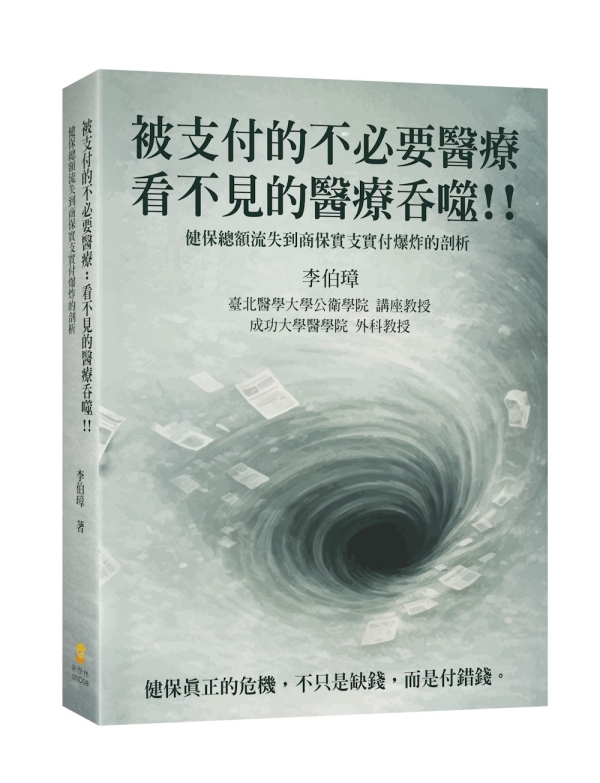
【New Book Promotion】Unnecessary Medical Care That Gets Paid For: The Invisible Drain on Healthcare!! An Analysis of How the Global Budget of National Health Insurance Leaks into the Explosion of Indemnity Commercial Health Insurance Claims By Director Po-Chang Lee (Published on April 24, 2026)
Unnecessary Medical Care That Gets Paid For: The Invisible Drain on Healthcare!!
An Analysis of How the Global Budget of National Health Insurance Leaks into the Explosion of Indemnity Commercial Health Insurance Claims
Po-Chang Lee
(Published on April 24, 2026)
Book purchase information: https://sharing.com.tw/product/index/5ND08
Book Features
This is not merely a book about the finances of Taiwan’s National Health Insurance (NHI). It is a book that reexamines what kinds of medical care Taiwan is actually paying for. Drawing from the intersection of clinical medicine, NHI governance, and insurance systems, the author argues that the core challenge facing today’s NHI is not simply insufficient funding, but misaligned payment priorities.
When the system continues to reimburse low-value medical services with limited marginal benefit, unnecessary care is repeatedly reproduced within a legal framework. In the end, this erodes point values, increases insurance premiums, exhausts healthcare manpower, and spills over into a loss-ratio crisis for commercial insurance.
The book’s greatest contribution lies in being the first to analyze NHI, self-paid healthcare, and commercial insurance within a single payment ecosystem. It shifts the discussion of unnecessary care away from moral blame toward institutional incentives, while proposing reform pathways involving co-payments, medical device governance, legal accountability, and smart governance.
This is not only a book criticizing current problems—it is a book calling for a recalibration of payment values and a rebuilding of institutional integrity.
About the Author
Po-Chang Lee
Current Positions
- Chair Professor, College of Public Health, Taipei Medical University
- Professor of Surgery, National Cheng Kung University College of Medicine
- Director, Center for Health and Welfare Policy Research, Taipei Medical University
- Consulting Physician, Shuang Ho Hospital, Taipei Medical University
Education
- M.D., Taipei Medical College
- Research Fellow in Surgery, University of California, Los Angeles (UCLA)
- Research Fellow in Transplant Surgery, Kyoto Prefectural University of Medicine, Japan
- Master’s Degree, Graduate Institute of Technology Law, National Cheng Kung University
Previous Positions
- President, Taiwan Society for Organ Donation and Transplantation Development
- Director-General, National Health Insurance Administration, Ministry of Health and Welfare (2016–2023)
- Chairman, Organ Donation and Transplantation Registry Center
- Superintendent, Tainan Hospital, Ministry of Health and Welfare
- President, Taiwan Society of Transplantation
- Professor of Surgery, National Cheng Kung University
Main Research Areas
- Kidney transplantation
- General surgery
- Organ donation promotion and advocacy
- National Health Insurance policy planning, implementation, and management
Honors and Awards
- Special Contribution Award for Organ Donation
- Lifetime Achievement Award, Taiwan Transplantation Society
- Distinguished Alumni Achievement Award, National Cheng Kung University
- Top 10 Managers, 100 MVP List by Manager Today Magazine
- Special Contribution Award, Medical Dedication Award
- Taiwan Medical Model Award
- Distinguished Alumni Award, Taipei Medical University
Preface
Why Did I Choose to Reopen the Debate on NHI Reform Through “Unnecessary Medical Care”?
As a physician, I have always placed the patient’s best interests first and taken responsibility through my professional expertise. During my service in the National Health Insurance Administration, my guiding principle was to ensure that healthcare professionals received fair compensation while the public enjoyed the genuine social welfare promised by universal health insurance.
From holding a scalpel in the operating room to leading national healthcare policy, I always believed that the best systems had already been designed by our public health predecessors. What remained was to make precise corrections and adjustments suited to Taiwan’s reality.
Over time, I came to realize that while medical fraud certainly exists and must be addressed, the true force consuming healthcare resources is not illegal fraud. It is the vast amount of unnecessary medical care that is legally reimbursed.
These services comply with regulations, pass administrative review, and may even be professionally defensible. Yet under the incentives of the payment system, they are repeatedly expanded, duplicated, and accumulated.
This led me to a deeper question:
What exactly are we paying for?
If the system continuously pays for medical services with limited benefit—or no real benefit to patients—then no matter how much we increase the total budget or adjust point values, healthcare professionals will never receive fair returns, and the healthcare system will never truly improve.
Key Arguments in the Book
1. Taiwan’s NHI problem is not simply “insufficient money”
The real issue is that resources are being spent on services that should not be prioritized, leaving too little for high-value care.
2. Unnecessary care is not a moral failure of doctors
Most unnecessary services arise legally and systematically. The problem lies in incentives, not individuals.
3. From tiered co-payments to user-pays principles
Reasonable co-payments can help patients and doctors pause and ask an essential question:
Is this service truly necessary?
4. Claims review alone cannot solve the problem
Traditional post-payment audits cannot detect accumulated patterns of low-value care. Reform must combine payment redesign, incentive reform, and AI-driven governance.
5. Cooperation between NHI and commercial insurance
Commercial insurers also suffer from the rising costs of unnecessary care. Sustainable reform requires collaboration, data sharing, and aligned incentives.
6. Why reform momentum may come from the insurance sector
Both NHI and private insurers bear the cost of waste. When both systems feel pressure, meaningful reform becomes possible.
Conclusion
I did not write this book to criticize anyone.
I wrote it to offer Taiwan another possible path for healthcare reform:
- Not blaming doctors
- Not morally accusing patients
- Not endlessly debating whether funding is enough
But instead:
Recalibrating what the system chooses to pay for.
If this book leads more people to ask one shared question—
What kind of medical care are we actually paying for?
—then it will have fulfilled my responsibility as a physician and participant in the system.
Core Message
What truly erodes the system is not an insufficient global budget,
but the continued payment for unnecessary medical care.
Healthcare reform is not about how much more money we spend—
it is about what kind of medical care we are willing to pay for.


