
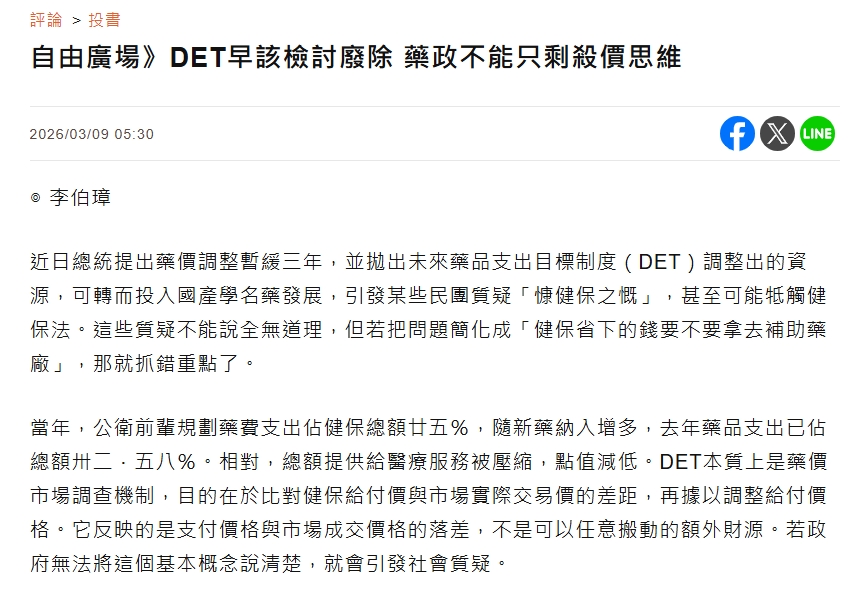
【Opinion Column】Liberty Times “Liberty Square” — DET Should Have Been Reviewed and Abolished Long Ago: Pharmaceutical Policy Cannot Be Reduced to Price-Cutting Alone
◎ Lee Po-Chang (Chair Professor, College of Public Health, Taipei Medical University)
Recently, the President proposed suspending drug price adjustments for three years and suggested that resources freed from adjustments to the Drug Expenditure Target (DET) system could be redirected to support the development of domestically produced generic drugs. This proposal has prompted some civic groups to question whether it amounts to “spending National Health Insurance (NHI) money generously,” and even whether it might violate the NHI Act. These concerns are not entirely unreasonable. However, if the issue is simplified to “whether money saved by the NHI should be used to subsidize pharmaceutical companies,” then the discussion misses the real point.
When Taiwan’s public health pioneers originally designed the system, pharmaceutical spending was expected to account for about 25% of the NHI global budget. Yet with the increasing inclusion of new drugs, pharmaceutical expenditures had risen to 32.58% of the total budget by last year. Meanwhile, the portion allocated to medical services has been compressed, resulting in lower reimbursement point values. In essence, the DET is a market survey mechanism for drug pricing, designed to compare the NHI reimbursement price with the actual transaction price in the market and then adjust reimbursement accordingly. It reflects the gap between payment prices and market prices—it is not an extra pool of funds that can be arbitrarily reallocated. If the government cannot clearly explain this basic concept, it will inevitably lead to public skepticism.
In a free market, pharmaceutical companies competing by cutting prices is often the most effective short-term strategy. While the DET may appear to help the NHI reduce costs, it can in fact lead to two serious consequences:
-
Price competition may compress drug quality.
-
Original-brand drugs forced to lower prices may eventually withdraw from the Taiwanese market.
The result would not be a more efficient system but rather increased risks to both drug quality and supply stability for patients. The core issue has never been just drug prices—it is whether drug quality and therapeutic effectiveness can truly be governed and monitored. Pharmaceutical expenditures that should be reimbursed ought to be paid reasonably to manufacturers. Simply forcing prices downward while avoiding the issue of quality and efficacy is not reform—it is governance by avoidance.
The National Health Insurance Administration (NHIA) has already established a “reporting system for unequal therapeutic effects of generic drugs” within the physician consultation room VPN system. This allows doctors to immediately report cases where they suspect differences in drug effectiveness when prescribing medications to patients. The NHIA regularly compiles these reports and provides the information to the Taiwan Food and Drug Administration (TFDA) for regulatory inspection, allowing targeted investigations rather than random sampling. This system should not exist merely for form’s sake—it should be actively used. If a particular generic drug receives an abnormally high number of reports, regulators should initiate inspections of the manufacturer. If the drug is confirmed to fail efficacy or quality standards, its removal from reimbursement coverage should be considered.
To be fair, the President’s intention—to enhance the quality and production capacity of domestic pharmaceutical companies and strengthen drug supply resilience—is not necessarily misguided. However, if the policy is simplified into the phrase “use the money saved from DET to support generic drugs,” it will not only invite criticism but also create the impression that NHI resources are being diverted. Policies can be defended, but only if their legal basis, financial logic, and governance objectives are clearly explained.
At the same time, we cannot pretend that the NHIA introduced the DET without reason. If pharmaceutical expenditures are not controlled, they will directly crowd out the total payment pool for medical services, lowering reimbursement point values and compressing the resources available for professional services such as clinical consultations, emergency and critical care, inpatient care, and surgery. If waste in pharmaceutical spending is not addressed, no drug pricing system will remain sustainable.
If the DET has been reduced to nothing more than an annual price-cutting mechanism, then it should indeed be reviewed—or even abolished. What is needed is a new governance framework centered on quality, efficacy, supply stability, and reasonable cost-sharing. Essential medications should receive reasonable reimbursement to ensure supply resilience. At the same time, mechanisms such as user-pay principles and partial cost-sharing should be introduced to curb unnecessary waste and overuse. That would constitute a pragmatic pharmaceutical policy.
Taiwan’s National Health Insurance system has reached a stage where structural problems can no longer be handled with vague language. The DET is neither a sacred institution nor a political cash machine. What should be paid must be paid; what should be inspected must be inspected; what should exit the system must exit; and reforms that are necessary should no longer be delayed. If the system only dares to cut prices but not manage efficacy, and only speaks of resilience while avoiding the issue of waste, the result will not be sustainability—but deeper imbalance.
Original source:
https://talk.ltn.com.tw/article/paper/1746138


