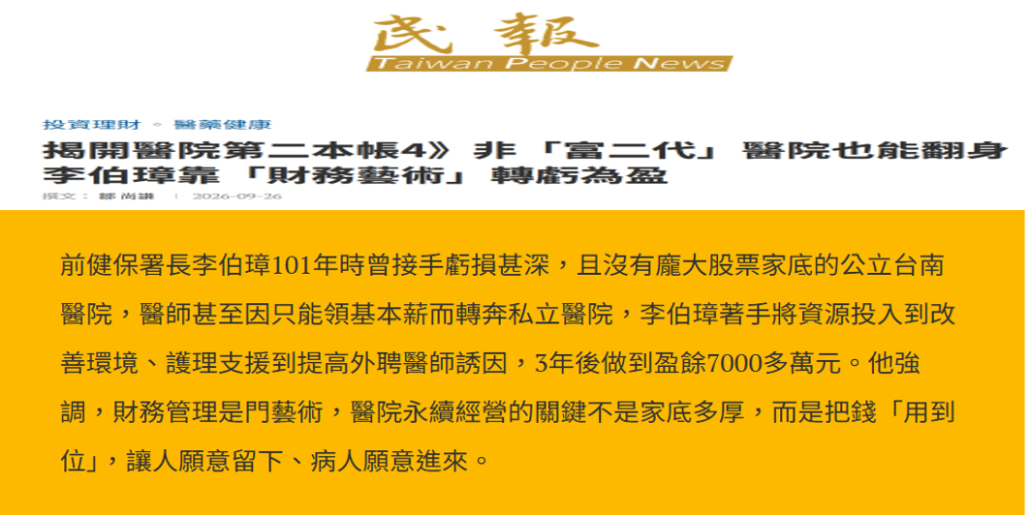
Uncovering Hospitals’ Second Set of Books, Part 4 | Even Hospitals Without Inherited Wealth Can Turn Around: How Lee Po-Chang Used the “Art of Financial Management” to Transform Losses into Profits
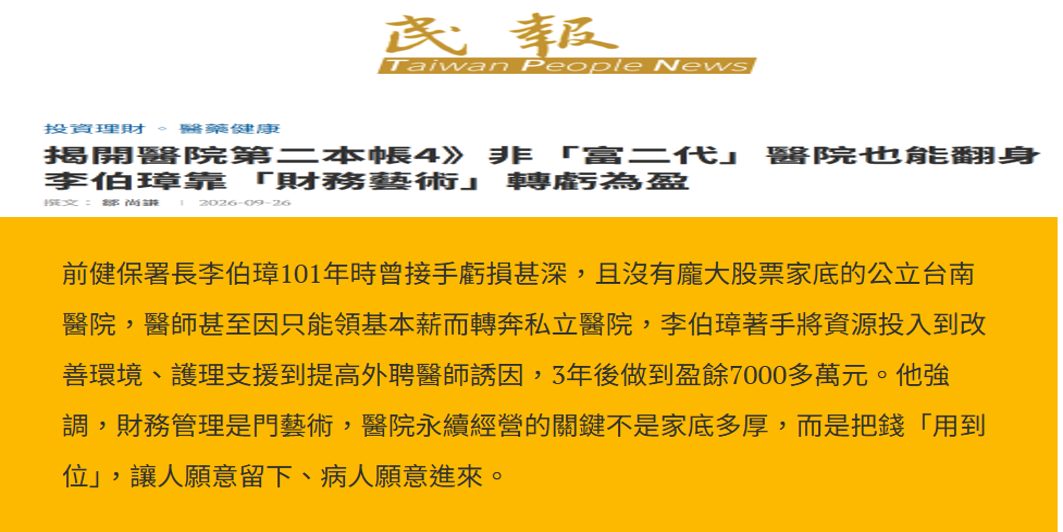
Financial losses on a hospital’s balance sheet can translate directly into the departure of medical professionals on the front lines. Lee Po-Chang recalled that when he took office as superintendent of Tainan Hospital on January 1, 2012, the hospital had recorded losses exceeding NT$50 million in the previous year and could not even afford to distribute performance bonuses.
Without competitive compensation, medical professionals inevitably began to leave. Lee recalled that less than six months after taking office, an attending physician told him that because the public hospital was struggling financially, he could only receive his base salary. With a mortgage to pay and another private hospital offering approximately NT$200,000 more in compensation, he had no choice but to leave.
“When a hospital cannot make money, doctors leave,” Lee said. He emphasized the harsh reality of hospital finances: a lack of surplus does not merely mean red figures on an annual financial statement. It also means that a hospital lacks the financial flexibility to improve compensation. When salaries are uncompetitive, medical professionals seek opportunities elsewhere, further weakening an already strained healthcare workforce and reducing medical service capacity.
Lee explained that for a public hospital without substantial dividend income or investment returns to rely on, survival ultimately depends on finding ways to improve the delivery of medical services.
No Luxurious Buildings: Starting with Restrooms, Patient Meals, and Nursing Assistants
Lee recalled that after becoming superintendent, one of his first priorities was renovating the aging restrooms used by patients every day. Rather than pursuing expensive facilities, he emphasized practicality: “Taiwan-made, clean, and functional is good enough.”
He also improved hospital meals, adjusting boxed meals that previously contained too much rice and too few vegetables, with the goal of ensuring that hospitalized patients could actually enjoy and finish their food. At the heart of Lee’s management philosophy was the principle of allocating resources from the patient’s perspective. The same approach applied to staffing.
Lee hired additional nursing assistants to handle administrative and other supporting tasks, allowing nurses to devote more time to professional patient care. He also advocated additional allowances for work associated with nurse-to-patient staffing ratios. Rest areas and facilities for physicians working in operating rooms were gradually improved as well.
These investments were not necessarily expensive, but they directly addressed the everyday challenges faced by healthcare professionals. They also highlighted an often-overlooked aspect of hospital finances: spending on staffing, compensation, and working conditions is not simply an additional expense. It is also an investment in sustaining and expanding future healthcare capacity.
Offering Physicians Better Compensation Brought Underutilized Operating Rooms Back into Service
Beyond improving the working environment, Lee recalled that some operating rooms at Tainan Hospital had relatively low utilization rates. To attract visiting surgeons, he increased financial incentives. For example, if a surgical procedure received 10,000 points in reimbursement under the National Health Insurance (NHI) system, he allocated 70% of the reimbursement to the physician from National Cheng Kung University Hospital who performed the surgery.
By comparison, physicians performing surgeries at other hospitals on a part-time basis typically received only 40% to 50%. The more attractive compensation encouraged physicians to provide services at Tainan Hospital.
“When physicians are willing to come, patients can undergo surgery. When patients come, the hospital can submit NHI reimbursement claims and generate revenue,” Lee explained.
Another turning point came during a dengue fever outbreak. Lee recalled that Tainan Hospital cooperated with government policies by making hospital beds available for dengue fever patients. Many residents entered the hospital for the first time during this period. After seeing the gradual improvements in its facilities and environment, some patients became willing to return for future medical care, helping the hospital establish a positive cycle of service utilization and financial recovery.
“By 2015, Tainan Hospital had achieved a surplus of more than NT$70 million,” Lee said.
The hospital went from a deficit exceeding NT$50 million in 2011 and a remaining deficit of approximately NT$1.5 million in 2012 to a surplus of more than NT$70 million in 2015. Only after achieving a surplus did the hospital have sufficient funds to distribute performance bonuses.
The key to this turnaround was not a sudden increase in stock dividends or investment income. Rather, it was the effective utilization of existing medical personnel, hospital beds, and operating rooms to deliver medical services.
On May 20, 2016, Lee became Director-General of the National Health Insurance Administration.
Hospitals with Inherited Wealth: Financial Advantages Are Not Inherently Wrong
In contrast, some hospitals begin with significantly different financial foundations.
Lee noted that medical institutions such as Chang Gung Memorial Hospital and Shin Kong Wu Ho-Su Memorial Hospital already possess stocks, dividend-generating assets, and other financial resources. These represent inherent advantages, much like inherited family wealth.
However, Lee argued that there is no reason to criticize these hospitals simply because they possess substantial assets. Nor should their financial strength be used as justification for reducing NHI reimbursements.
“If a medical procedure costs NT$10,000 but the NHI system reimburses only 9,000 points, we should examine whether the reimbursement is reasonable. We cannot simply assume that hospitals should absorb the difference because they have additional income from stock investments,” Lee said.
Taiwan’s NHI global budget is projected to exceed NT$1 trillion in 2027. Lee emphasized that the long-term sustainability of healthcare cannot depend solely on continuously expanding the NHI budget.
Essential medical services must receive adequate reimbursement. At the same time, unnecessary healthcare utilization must be reduced to ensure that limited medical resources are directed toward those who genuinely need them.
Original Article Source:https://www.peoplenews.tw/articles/investment-financialmgmt/57621


